
Providing Logistics in Swan Hill and Surrounds

Providing Logistics in Swan Hill and Surrounds

OUR Terms and Conditions 


Terms & conditions - effective 1/7/2025


We’ve updated our Terms and Conditions (T&Cs) to make them clearer, more user-friendly, and compliant with Australian laws, including the Australian Consumer Law. These updates, effective from 1st July 2025, apply to all new bookings and Credit Account agreements. For existing contracts, the new T&Cs will apply to services booked or performed after 1st of July 2025, unless otherwise agreed in writing. By booking Services or continuing to use our Services after this date, you (and any Consignee) accept the updated T&Cs. Key changes include improved credit terms, clearer subcontractor protections, and enhanced dispute resolution processes. We’ve worked with legal experts to ensure fairness and transparency for all customers. Contact our team at enquiry@ptg.com.au with any questions or to discuss the transition. Thank you for choosing Pickering Transport Group.


Amendment - Effective 16/3/2026

Fuel Levy will now be calculated weekly, moving from monthly. Please click here to read more.


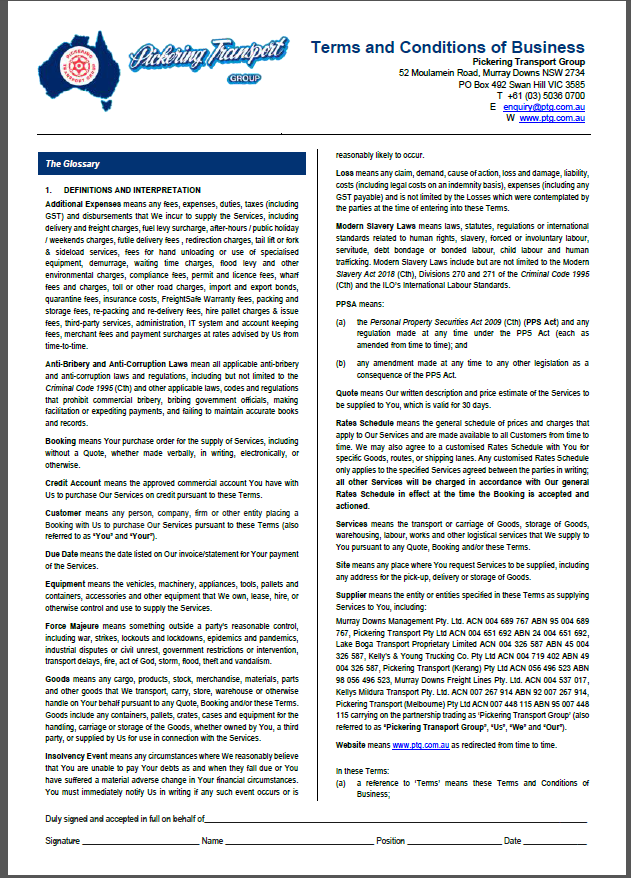
click here to view the latest terms & conditions


  • We now require your written acknowledgement due to the changes in the T&C’s.

Please print off and return a signed copy to ar@ptg.com.au.  Alternatively, we have created this simple form that you can sign online. Simply fill out this form:


Company Policies 


Log into to see the company policies

Fuel Levy (Surcharge) 


Changes - 16th march 2026

Effective immediately, we will transition from our current monthly fuel levy review to a weekly review schedule.

This adjustment will allow us to better capture and respond to large price swings, helping maintain stability in our services.

  • The current fuel levy applicable as of 1st March 2026 is currently 17%.
  • The next rate (33%) will affect bookings for Monday, 16th of March 2026.
  • From then on it will be each Monday, with price notification available on Friday of the preceding week.


Subscribe for fuel levy notifications

How does it work?

The cost of fuel is one of the biggest expenses for any transport company and varies dramatically with movements in market prices. Pickering Transport Group incorporates a Fuel Levy so that your freight rates are kept stable. Movements in the fuel price purchases are tracked on a weekly basis and averaged out for the proceeding month. We are then able to generate the applicable fuel levy for the upcoming month. This allows us to inform you ahead of time if there will be an increase or a favourable decrease.


UPDATE (16-3-2026) Going forward, we will be using a weekly adjusted fuel levy and will be adjusted each Monday. It will be based on our average fuel buy price for the preceding time period.


Refer to the table below for details.


Please email fuel@ptg.com.au if you would like to receive our monthly fuel newsletter.

Fuel Levy - 2026

  • Monday 23rd March - 39%
  • Monday 16th March - 33%
  • 1st March - 17% 
  • February - 16%
  • January - 17% 

Fuel Levy - 2025

  • July - 17% | August - 18% | September - 18% | October 18% | November 18% | December 19%

  • January - 18% | February - 20% | March - 20% | April - 18% | May - 17% | June - 16%

Fuel Levy - 2024

July - 20% | August - 20% | September - 19% | October - 16% | November - 17% | December - 17%


January - 20% | February - 20% | March - 23% | April - 22%| May - 22%| June - 20%


Fuel Levy - 2023

January - 23% | February - 22% | March - 21% | April - 20% | May - 20% | June - 17%


July - 17% | August - 19%| September - 24%| October - 27%| November - 27% | December - 23%
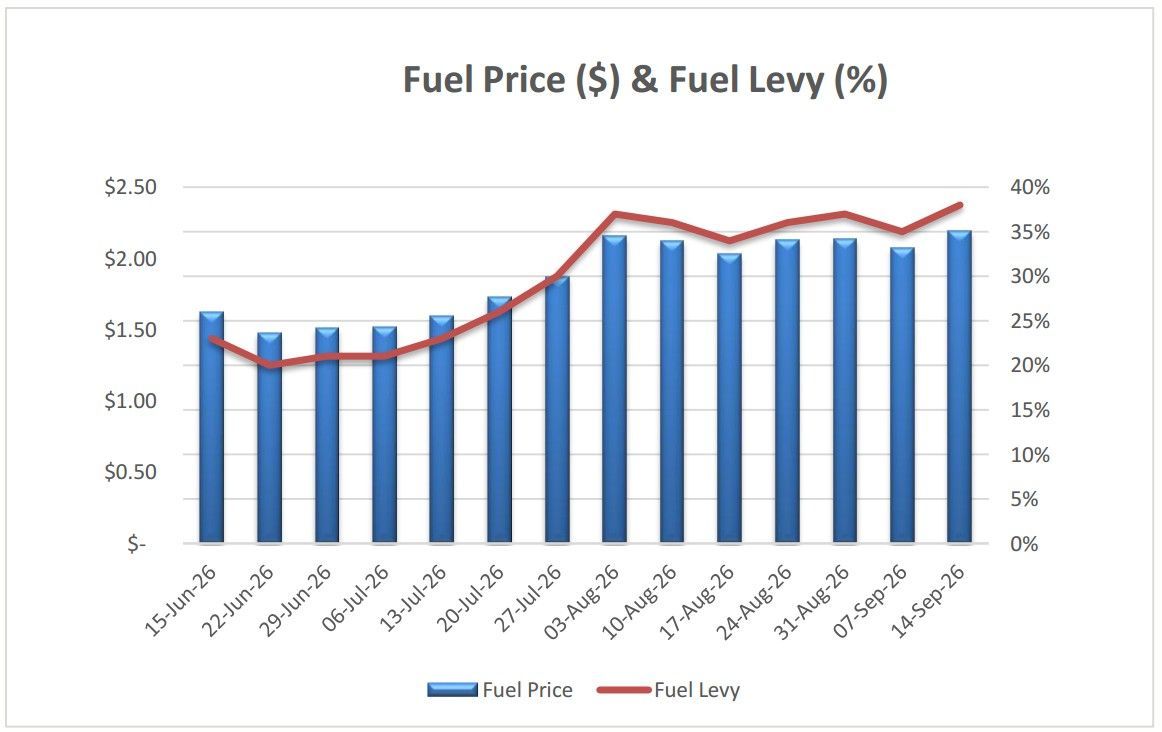
Fuel Graph with Applicable Fuel Levy

Best Practice Guidelines for Packaging 


All parties in the supply chain have a responsibility to ensure that goods can be transported safely, with the minimum of risk to people and the goods themselves. While our team is trained to handle your goods with care, if they are not packaged properly the chances of them being damaged in transit is significantly higher. This guideline lays out the standards we require to transport your goods safely so we can ensure that they get to their destination as intended. Please note that undercover storage cannot be guaranteed and as such all freight must be appropriately packaged to prevent damage from sun exposure or weather events.


Click Here to Download These Guidelines as a Printer Friendly PDF Copy

Parcels


  • The Carton

    • Ideally, you should be packaging your goods in the manufacturer's carton or a similar new carton. If the carton is used, you need to ensure it is in excellent condition with no compromise to its structure.
    • The carton must have its internal flaps intact which add to the structure of the parcel. If these are not in place, do not use the carton.
    • If the parcel weighs 12kg or more, you must use heavy duty double-layered board to mitigate the risk of the goods falling through the bottom of the carton.
    • While we strongly encourage you to use the manufacturer's original cartons, displaying branding from high-end manufacturer's is not encouraged, with generic brown cartons being preferred.
  • Sufficient labelling

    • If there are any labels on the box from a previous shipment, they must be removed. Cartons with multiple labels have a significantly higher chance of being lost in transit.
    • Noting that a carton often travels thousands of kilometres and touches many hands, ensure that your labels are stuck down adequately for transit.
    • Labels must always be on the top of the carton where they are easy to read and never underneath the carton.
    • Handy tip: place a duplicate address label inside the package in the event that your external label comes off.

  • Internal Packaging

    • While the outside structure of the carton is critical, packing your goods well internally is just as important.
    • Do not leave significant excess space in the carton around the goods. This will mean that your goods will stay secure in transit and not move around the carton, reducing the chances of them being damaged in transit.
    • For any small spaces that remain, place cushioning material internally including high quality foam, industrial paper or similar material to minimise movement in the carton.
    • If your item is fragile, wrap each item separately with bubble wrap so that it can withstand the long journey ahead.

  • Sealing your Carton

    • When sealing the carton, use strong tape designed for shipping.

    • Ensure that all exposed edges of the carton are sealed using the H-tape method, as seen in the diagram below.


Parcel Box | Swan Hill, Vic | Pickering Transport Group

Satchels


  • Cushioning

    • Even though your item may be small, it still has a significant journey ahead of it, often entailing several people handling it and potentially several thousands of kilometres of travel. To withstand the long journey, your goods must have enough cushioning around the item to make sure it isn't damaged, generally in the form of high-quality bubble wrap.
    • Handy tip: Once your item has been bubble-wrapped, place a layer of double-sided board around the item, which will ensure that it stands its best chance of being delivered safely.
  • No Sharp Edges

    • All parcels ultimately are touched by people. If items with sharp edges are placed n a satchel, they will more than likely protrude from the satchel exposing our team and the consignee to risk of being injured. Ensure that items with sharp edges travel in a carton, or at a minimum, place abundant bubble wrap placed around the edges, which cannot be pierced by the item itself.
  • No Liquids or Glass

    • Items containing liquids or glass should never travel in a satchel. Liquids and glass must always be placed in a suitable carton with adequate protection around them, and limited space for movement, to ensure they withstand the journey.

Palletised freight


  • THE PALLET

    • Using a pallet that is in great condition, will minimise the risk of it and your goods being damaged in transit. Hard wood timber or robust plastic pallets are all adequate provided they are in good condition with no loose panels. Soft wood timber pallets, while cheaper, are more susceptible to fork-lift damage and ideally should not be used.
    • The pallet must be able to support the load of your shipment. Small skids bearing significant weight are not advised, with the risk of the load tipping over.
  • STACKING A PALLET

    • Pallets must be stacked with the heaviest cartons at the bottom of the pallet and lighter cartons on the top.
    • It is critical that the cartons used are of high quality, especially when they are bearing the load of other cartons on top of them. Poor quality cartons will collapse, potentially exposing the entire pallet of goods to damage.
    • To improve the pallet “density” and stability, if the cartons stacked on the pallet have a large base, then additional cartons can be stacked directly on top of them. However, if the cartons stacked have a small base, they should be stacked in an overlapping “brick” pattern.
    • Don't pack cartons too high. The higher you go, the greater the chance of the pallet collapsing or tipping over and your goods being damaged.
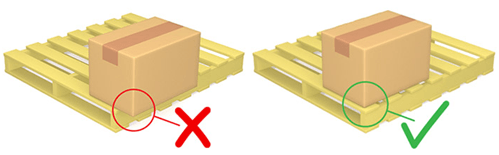
    • Cartons must not overhang the pallet edge as it exposes the goods to damage during normal handling by forklifts, as can be seen in the diagram below. A pallet which has overhang can also reduce individual carton strength by more than 30%.
  • Securing the Pallet

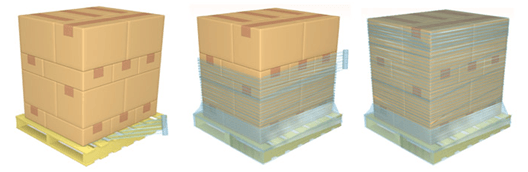
    • Using quality shrink-wrap is strongly recommended to ensure that your goods arrive at their destination, and you can never use too much. While stacking your cartons well is critical, shrink-wrap gives your pallet further structure and holds your cartons together over the long journey as can be seen in the diagram below.
    • For heavier pallets, metal or industrial quality plastic strapping, when applied correctly, is an ideal way to secure your shipment ensuring that your cartons remain in place on the pallet.
    • Pallets that are strapped should be done so in all directions (north to south + east to west) and not only in 1 direction, which may still allow small cartons to slip out.
    • Handy tip: ensure that you do not apply the straps too tightly as this can easily damage your cartons.
    • Label each pallet in your shipment with complete addresses, telephone numbers and information, including the postal codes for the shipper and the consignee. Place multiple labels on each side of the pallet for ease of identification.
Image of a Securing Pallet with Parcel | Swan Hill, Vic | Pickering Transport Group
Parcel Box with a Pallet | Swan Hill, Vic | Pickering Transport Group

Heavy Unboxed Items, Lengths & Tubes


  • Heavy unboxed items

    • Larger unpackaged items such as engines or industrial equipment must be strapped to a pallet to ensure they do not move in transit, which can cause significant damage to people and goods.
    • Use additional padding to protect any sharp edges which may be exposed.
    • Items should then be crated to further reduce risk by fully enclosing the goods with a quality hardwood crate. Spas in particular must be crated for transport.
    • Roller doors must have a corrugated iron protective sheet or be crated.

  • Lengths & Tubes

    • Heavy and long bundled items that do not fit in a case or crate must be strapped with steel strapping to a skid or pallet so they can be forklifted. If packed on a skid, the skid must be robust enough to withstand the weight of the goods.
    • Often lengths and bundles are required to be lifted by forklifts and placed on the ground which means they need to be protected from impact, scratching or denting.
    • Lengths with exposed painted surfaces must be protected by heavy duty wrapping to prevent any damage to the surface.
    • Plaster and any other fragile packs should have packing sheets around all exposed edges.

Freightsafe | Swan Hill, Vic | Pickering Transport Group

FIND OUT MORE

CONNECT WITH US